Bridles are an integral part of English riding, as they ensure effective communication and the transmission of aids between rider and horse. In recent years, the debate surrounding anatomically shaped bridles has grown increasingly heated. And for good reason: we horse people are increasingly questioning why we use certain equipment and how it affects the wellbeing of our equine partners. Particularly intriguing is the so-called ‘functional bridle’ – hailed by many, dismissed by others as a marketing gimmick. So here at Kavalkade, we asked ourselves: what is really behind the idea of an anatomical bridle for horses? And how does it differ from the classic version? We provide the answers in the fourth and final instalment of our bridle series.
What exactly is an anatomical bit?
In short: an anatomically shaped bridle takes into account the sensitive anatomy of the horse’s head. It is about much more than just a stylish design. The following points are crucial:
- Neckband: Wider and softer, to distribute pressure more evenly and avoid restricting movement around the sensitive ears.
- Noseband: Shaped to protect the sensitive nerve pathways on the bridge of the nose and the lower jaw.
- Side straps: Specifically designed to avoid the main nerve pathways in the horse’s head.
The aim
Reduce pressure points, relieve pressure on the nerve pathways and provide the horse with greater comfort.
Classic vs. functional bridles – what’s the difference?
Many bridles these days are labelled ‘functional bridles’ – but just because a bridle is labelled ‘anatomical’ doesn’t necessarily mean it’s actually anatomically shaped. Unfortunately, there is no official definition. However, there are a few distinguishing features that can help you.
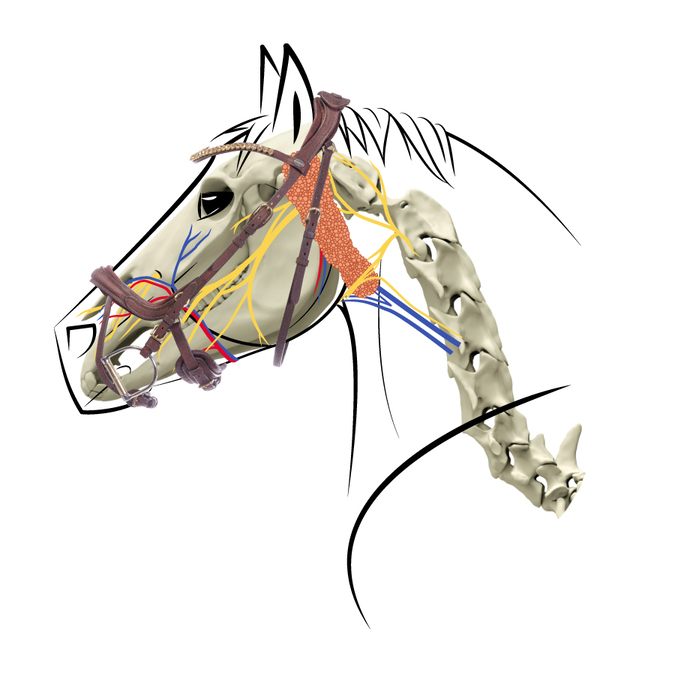
Features of the functional bridle:
- Reduced or cleverly positioned side straps (single-strap bridles or bridles with straps curving backwards)
- Nosebands that specifically leave key nerve centres and pathways exposed
- Anatomically shaped neck piece with a wide contact surface
- Freedom of movement thanks to the removable safety strap
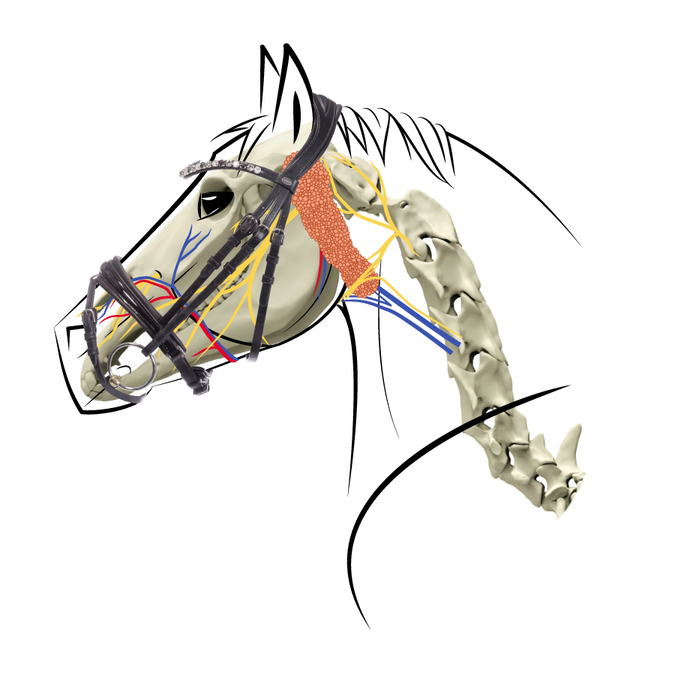
Features of a classic bridle:
- The neck piece is well-padded and sufficiently wide
- The side straps are positioned correctly – one finger’s width behind the cheekbone
- Noseband fastened loosely – 2 fingers’ width below the cheekbone
Important
Even with the best bridle, it is never possible to completely avoid pressure on certain points (e.g. the trigeminal nerve) – unless you use special riding halters such as the Hanoverian model.
What makes our functional bridles at Kavalkade so special?
We deliberately focus on well-thought-out design that delivers real added value. Our highlights:
- The number of side straps has been reduced from 2 to 1, to allow more space around the nerve pathways.
- A curved noseband protects the nerve pathways from the nape of the neck to the nostrils.
- The side strap does not press against the nostrils, allowing for easier breathing.
- A higher-set throat strap allows for greater freedom of movement at the cheek straps.

You’ll also find many of these features in our classic bridles:
- comfortable fit
- removable locking straps
- anatomically wide neck straps

Functional bridles in practice: what we’ve learnt from experience
Here at Kavalkade, we’re honest: an anatomically shaped bridle doesn’t automatically make everything better. But it can make a huge difference, especially with sensitive horses.
Many horses clearly show when something is causing them discomfort:
- Poor support
- Loss of appetite
- Restlessness when putting on the bridle
Others, on the other hand, simply ‘work’ – but suddenly come into their own once the equipment is finally fitted perfectly.
So here’s our advice: get to know your horses! Experiment and feel your way forward. Perhaps your Mexican bridle is already the best anatomical compromise? Perhaps the classic one is simply good enough?
Incidentally, there are always exceptions – for example, horses that have a warmblood head length but need a noseband designed for a thoroughbred. In this case, you can customise your bridles using our Cre8 system. It doesn’t have to be any more expensive than a ready-made model!
Conclusion: Which bridle is the right one?
“What does my horse really need?” This is a question that horse owners should definitely ask themselves. Take a close look at your equipment, review how you handle your horse, and take its anatomy into account. It may well be that your horse has never complained before, but with new equipment it will perform at its very best.
Our motto at Kavalkade is: the more comfortable your horse feels, the more rewarding your partnership will be. And that’s what riding is all about!