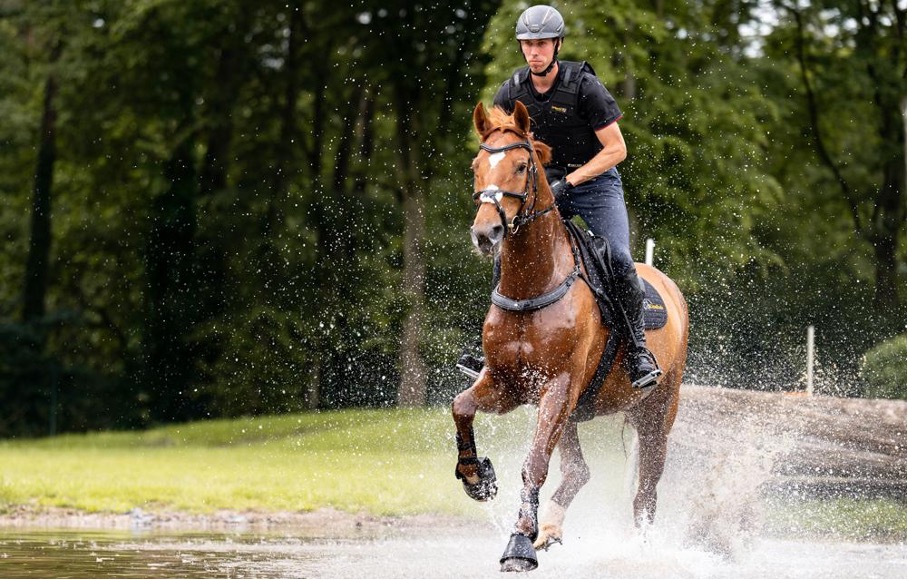
Why do you need a breastplate for your horse? And more importantly: which one is actually the right one for you and your horse? This is precisely where things can quickly become confusing for many riders. That’s because there are not only visual but, above all, functional differences between 2-point, 3-point and 5-point breastplates.
For many people – particularly in show jumping, eventing or cross-country riding – breastplates have long been part of standard kit. Nevertheless, we see time and again that they are either used incorrectly or not used at all, even though they would be useful.
In this article, we’ll therefore take a look together at when a breastplate really makes sense, what benefits it offers and how the different models differ. We’ll also show you what to look out for when choosing one – so that you can find exactly the right breastplate for your horse and your intended use.
What exactly is a breastplate?
A breastplate is an accessory that is attached to the saddle and runs across your horse’s chest. Its main purpose is simple but crucial: to hold the saddle in place and prevent it from slipping.
Depending on the model, it may also:
- improve lateral stability
- influence the movement
- or optimise the rider’s influence
When is it a good idea to use a breastplate when riding?
A breastplate is particularly useful when riding if:
- your saddle slips backwards
- your horse has a pronounced shoulder position or a low withers
- if you do a lot of jumping or are out and about off-road
- your horse is young and is still developing physically
- where quick changes of direction are required
In short: whenever movement and dynamism come into play.
Important!
A girth does not replace a well-fitting saddle, but helps to maintain its position when special requirements arise.
The benefits of a chest harness at a glance
A well-fitting breastplate offers you several benefits:
- A stable riding position without the hassle of constant readjustment
- Greater safety for you and your horse
- Relief for the horse’s back through pressure distribution
- Enhanced appearance, particularly on tournament models
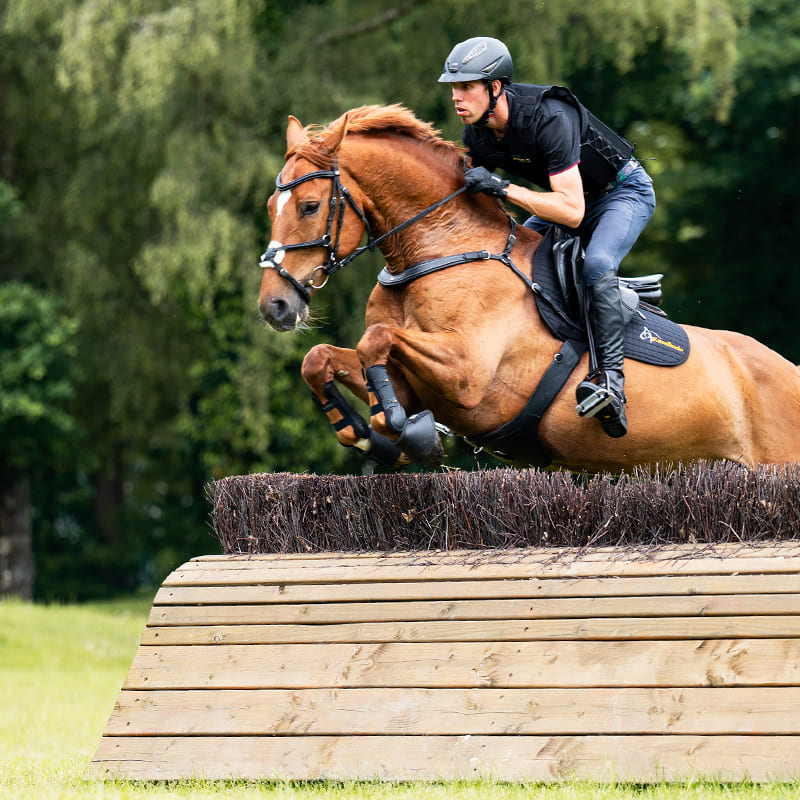
What types of evidence are there?
Now it gets interesting, because not all chest harnesses are the same. Chest harnesses often differ in the number of attachment points, which affect their stability, freedom of movement and range of use. And this is precisely where most people tend to make the wrong choice. Let’s take a closer look at the different models.
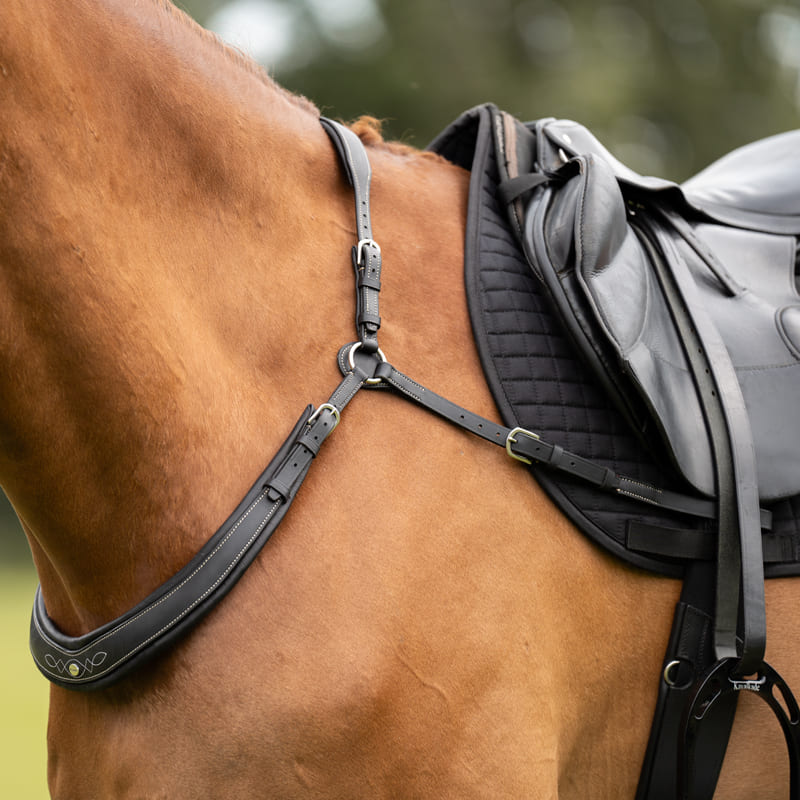
The 2-point front harness: minimalist & allows for freedom of movement
Features:
- Mounted on the left and right of the saddle
- No strap between the front legs
Advantages:
- hardly any restriction in the shoulder
- maximum freedom of movement
- a very light version
Ideal for:
- Horses with a well-fitting saddle
- quiet work
But watch out!
Off-road in particular, it can be dangerous if the belt is too loose – think of it getting caught.
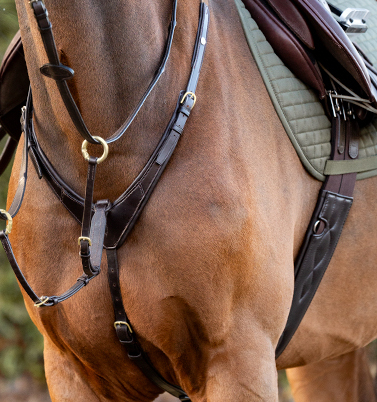
The 3-point front loader: the all-rounder
Features:
- 2 mounting points on the saddle
- an extra point on the saddle girth (between the front legs)
Advantages:
- significantly greater stability than a 2-point front rig
- effectively prevents the saddle from sliding backwards
- a good balance between support and freedom of movement
Ideal for:
- Horses with a rounded ribcage or a low withers
- Show jumping
- Terrain and versatility
The difference between the high and low 3-point front position
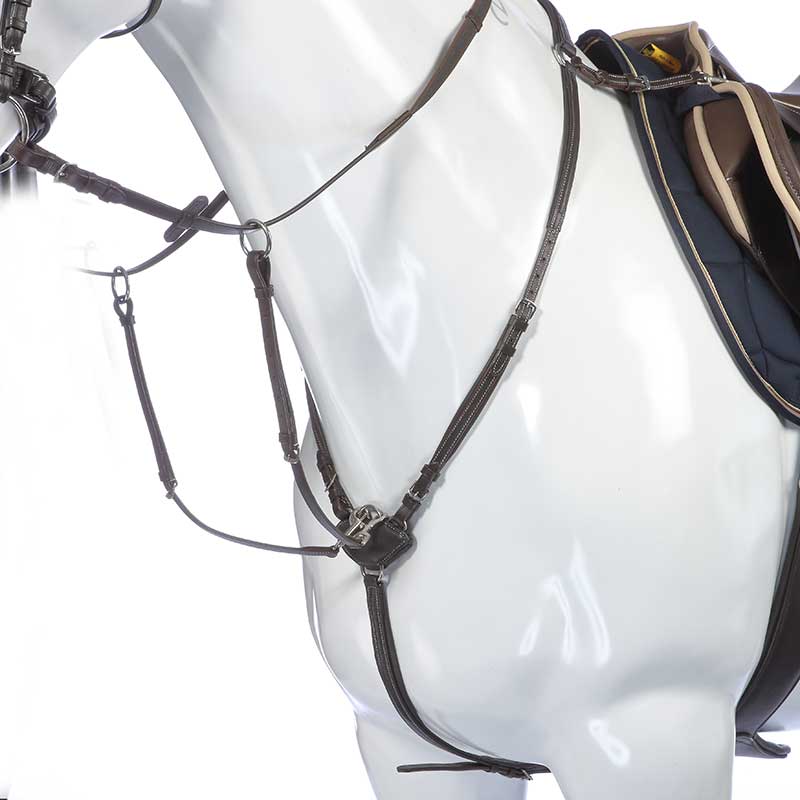
Tall 3-point front frame
With the high 3-point front girth, the connection to the saddle girth sits close to the withers and is attached to the upper saddle rings. It effectively stabilises the saddle to prevent it from slipping backwards, without exerting pressure on the breastbone or shoulders when correctly adjusted. Ideal for horses with a strong neck base, a high withers or a strong tendency to push backwards. In short: greater stability during competition, without severely restricting the shoulders.
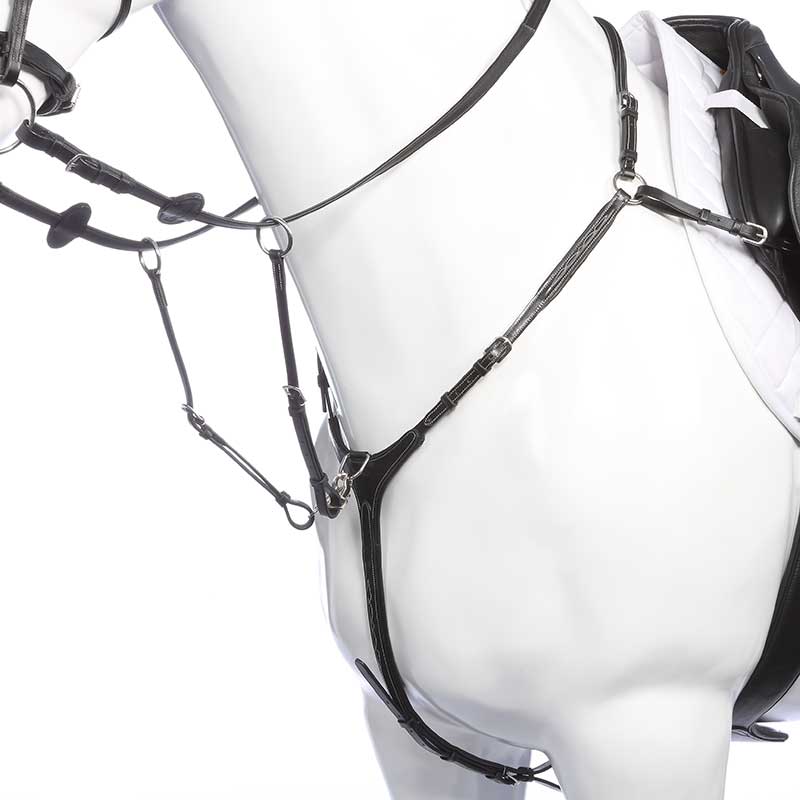
Deep 3-point front frame
The low 3-point breastplate is attached to the girth straps at shoulder height and thus stabilises the saddle against slipping backwards much more effectively than the high version. Although many riders tend to opt for the high 3-point fastening more often – usually out of habit or because it seems simpler – the low fastening clearly has the advantage when it comes to stability. It is particularly suitable for horses with a rounded rib cage, a flat withers or a strong forward drive. Conclusion: maximum stability when you really need it.
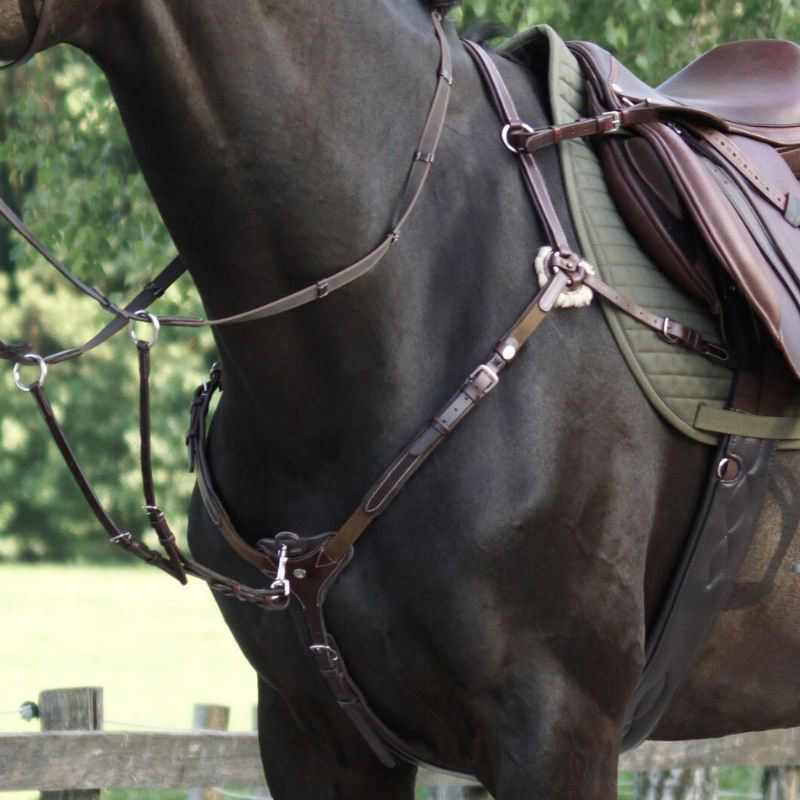
The 5-point chest harness – maximum control during sport
Features:
- Two mounting points on the saddle
- A point on the saddle strap
- Two additional fastenings on the saddle flaps or girth straps (lateral stabilisation)
Advantages:
- maximum stability
- prevents the saddle from moving both backwards and sideways
- very stable during high jumps and rapid changes of direction
Application:
- Jumping at a higher level
- Versatility and off-road capability
- Horses with pronounced shoulder action or a difficult saddle position
Why are there these differences in front-end components?
The various types exist because:
- Horses vary greatly in terms of their anatomy.
- Different disciplines have different requirements.
- Greater stability must always be weighed up against freedom of movement.
Our rule of thumb
As much stability as necessary – as few restrictions as possible.
A chest strap with or without a strap between the front legs – which is best?
Whether or not to use a girth strap between the front legs isn’t a matter of style, but depends entirely on what you’re riding. A breastplate without a centre strap (2-point) gives your horse significantly more freedom of movement forwards. This is ideal for eventing, hunter riding or long jumps such as the water jump. Here, your horse needs to be able to lengthen its stride, bring its shoulder well forward and stretch its body.
With high jumps, such as steep jumps, the movement looks different: your horse jumps more vertically, arches its back more and tucks its front legs closer under its body. During this phase, a cross-girth often hangs loosely anyway and has little effect.
The key question, therefore, is not ‘with or without’, but whether you really need it. Particularly when riding cross-country or over long jumps, a two-point breastplate can be entirely sufficient and even offers an important safety benefit: a breast strap set too long can sag, allowing your horse to step into it. So the rule is: as much as necessary, as little as possible.
What should you look out for when buying?
- high-quality, soft leather or well-padded materials
- multi-position adjustable straps
- ample shoulder room
- suitable for the riding style and the type of horse
Conclusion: Which chest harness is the right one?
Ultimately, it’s quite clear: you only need a girth if your saddle slips backwards whilst riding. If you don’t have this problem, you can do without the girth. And if you only want to use it for its martingale function, a simple martingale solution is often sufficient.
However, if a girth is really necessary, choosing the right one is key: 2-point, 3-point or 5-point – it’s not the appearance that matters, but how much stability your saddle needs without restricting your horse’s freedom of movement. When chosen correctly and adjusted properly, it prevents the saddle from slipping and ensures greater safety in the saddle. At the same time, your horse remains supple in its movements, and that is precisely what we aim for at Kavalkade: functionality that supports without interfering, for an all-round harmonious riding experience.
FAQ: The horse’s forelegs
For everyday use, we usually opt for the classic 2-point girth. It has a simple design, is quick to fasten and provides solid stabilisation for the saddle, making it ideal for regular training and leisurely rides. If you need a bit more support, a 3-point girth is a good choice.
We generally distinguish between 2-point, 3-point and 5-point front harnesses. Whilst the 2-point model is rather simple, the additional attachment points on the 3- or 5-point front braces provide greater stability. There are also variants such as high or low front braces – depending on where they are attached to the saddle and how much force they exert.
A breastplate comes into play whenever the saddle tends to slip backwards – for example, on horses with a low withers, a rounded ribcage or a strong forward drive. It also provides extra security when riding cross-country, jumping or in demanding sporting situations.
To ensure your leather breastplate lasts a long time, you should clean and condition it regularly. Dirt and sweat are best removed with a damp cloth or leather cleaner; afterwards, apply leather conditioner to keep it supple. Important: don’t use too much conditioner and make sure to let the leather dry thoroughly in between applications.
A clear sign is a saddle that slips backwards whilst riding or feels unstable. Even if you frequently have to readjust the girth or your horse has a body shape that is unsuitable for the saddle position, a breastplate may be a good idea. The key factor is always the overall picture, taking into account fit, movement and intended use.