The secret to a good girth lies not only in its shape, but also in that of the horse. Every horse is built differently, and its individual anatomy plays a key role in determining which girth is suitable and what the correct girth position should be. By paying attention to this, you can have a positive impact on your horse’s biomechanics, performance and health. If, on the other hand, something is wrong with the equipment, horses will quickly let us know through restless or unhappy behaviour. In this first part of our girth series, we’d like to raise your awareness of this important topic and provide you with some basic knowledge about the horse’s anatomy in the girth area. In the following articles, you’ll learn about the different types of horse anatomy and which girth is particularly ergonomic for which type of horse.
The key points here are:
- Sternum
- Muscle groups (abdominal muscles)
- Fascia
Basics of equine anatomy in the girth area
Depending on the horse’s anatomy, girth positions can vary considerably. However, there are two important points to bear in mind for all horses:
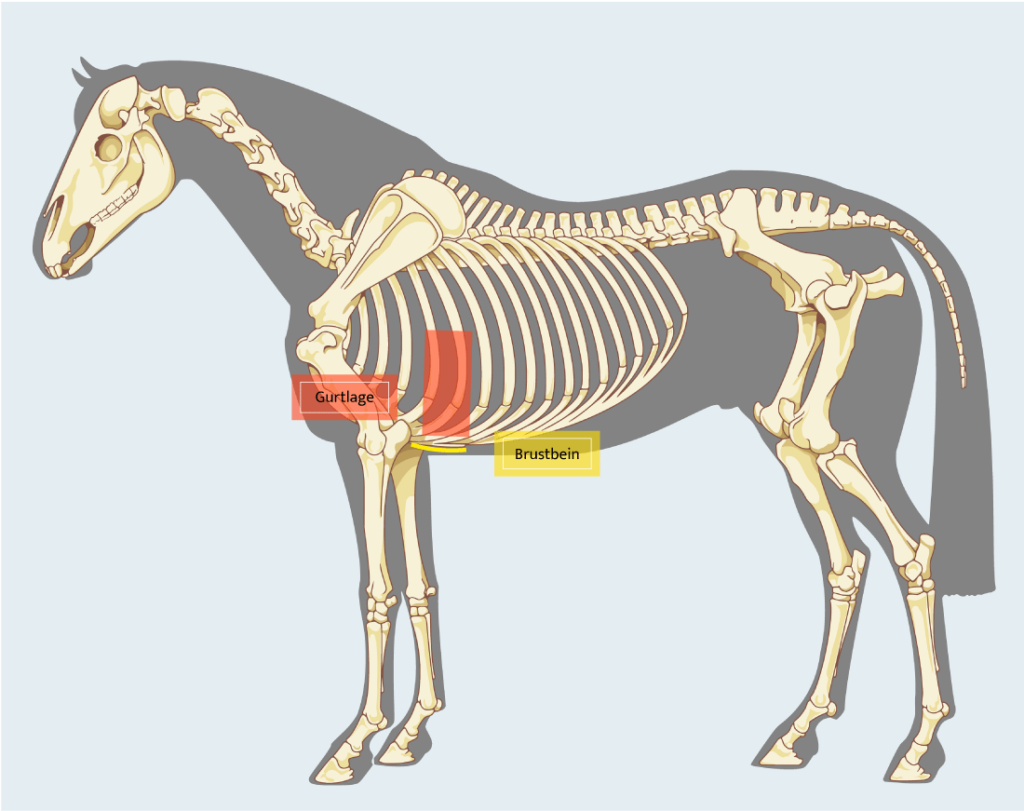
- The girth must NEVER lie behind the breastbone.
- There must be sufficient elbow room; to ensure this, the strap should sit about a hand’s width behind the elbow.
Sternum: Why is an ergonomic saddle girth important?
The sternum is a sensitive area, and the pressure exerted by the saddle girth on this bone is always problematic. If, for example, a girth does not fit properly, too much pressure is exerted on the lungs and heart.
The most sensitive area around the girth is directly behind the elbow; this is where the force of the girth is felt most strongly. An ergonomic saddle girth is positioned far enough away from the elbow to allow the necessary freedom of movement.
The front edge of the girth exerts the most pressure on the breastbone. Depending on the horse’s anatomy or the choice of an unsuitable girth shape, this pressure is exacerbated.
Sensitive areas of the horse’s body
Various muscle groups
Saddle girths that do not fit properly or are too tight also restrict the movement of other muscles in the horse, such as the abdominal muscles or the muscles of the shoulder girdle. The abdominal muscles help to arch the back and lift the pelvis (to establish the centre of gravity).
The muscles of the shoulder girdle support the entire musculoskeletal system in the front part of the body and also act as shock absorbers. If a girth is too tight, a horse finds it harder to arch its back and consequently tends to run more on its forehand.
The skin muscle
The skin muscle in horses is particularly sensitive and, due to its rich network of nerves, reacts strongly to external stimuli. The skin muscle is at its thickest (approx. 1.5 to 3 cm) in the area where the girth sits, and stimulation of this area triggers significantly more reactions within the horse’s body than is the case in other areas. So, when a horse feels the constant pressure of the girth, this leads to prolonged stimulation of the skin muscle, which can result in twitching. If nerves are permanently damaged, ‘chronic twitching’ may develop. The first warning signs include chafing or pressure marks, as well as thicker, scaly scarred skin.
Good to know: During the support phase of the canter, the greatest pressure is exerted on one front leg at a time and behind the elbow. The faster the pace, the greater the pressure!
The fasciae
Whether human or horse – we all have fascia. It lies directly beneath the skin and forms our connective tissue, which is linked to our organs, muscles and tendons. If, for example, we tighten the girth too tightly, the fascia can become constricted and restrict the horse’s movement. This can lead to tension or even unnecessary strain on the ligaments.
Horses are unique creatures, and every animal has its own individual physique. We therefore recommend that you familiarise yourself with the anatomy and structure of the horse’s body before purchasing any products. It is important to understand that no single product can be used universally for all horses – whether it is a bridle, a girth or a saddle.
In Part 2 of our saddle girth series, we’ll tell you more about the different types of our horses …
… and about the most common types of horse anatomy.