Having learnt the basics of equine anatomy in the first part of our saddle girth series, we’re now going to delve deeper into the subject. In this second part, we’d like to introduce you to the fascinating world of horse types and their respective characteristics. At the same time, we’ll take a look at the different types of saddle girths most commonly available on the market and explain the differences between them.
A look at the most common body types of our horses
Horses, fascinating creatures with a wide variety of breeds and body types, have given rise to very different types throughout their history. Each type of horse has its own distinctive features and characteristics, which make it particularly well-suited to specific tasks and requirements. Below, we’ll introduce you to the four most common horse conformation types and take a closer look at the anatomy in the girth area.
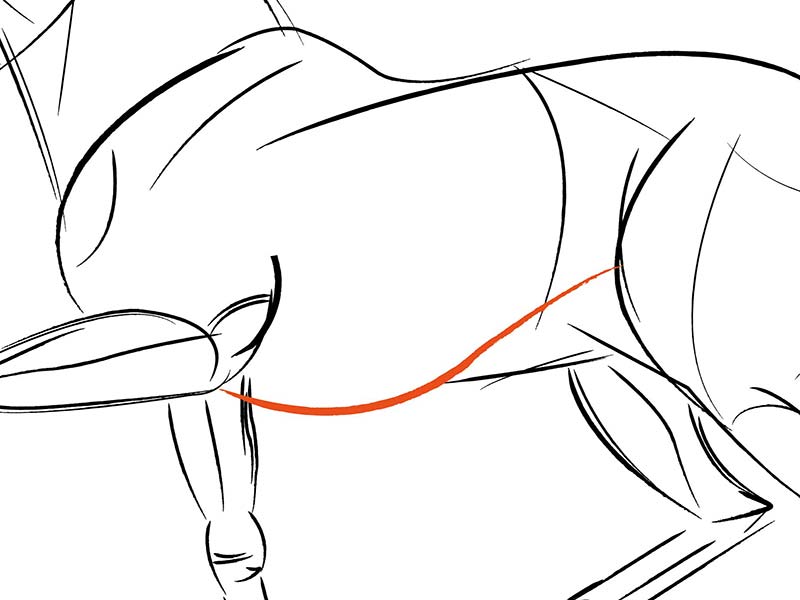
Horse type 1
The ends of the sternum and the rib arches point slightly downwards.
This body type results in a slightly less pronounced girth position, in which the saddle girth automatically tilts slightly forwards.
Horse type 1 is often found in dressage, where precision, balance and subtlety of aids are crucial – requirements that this type of horse is well equipped to meet thanks to its sturdy build.
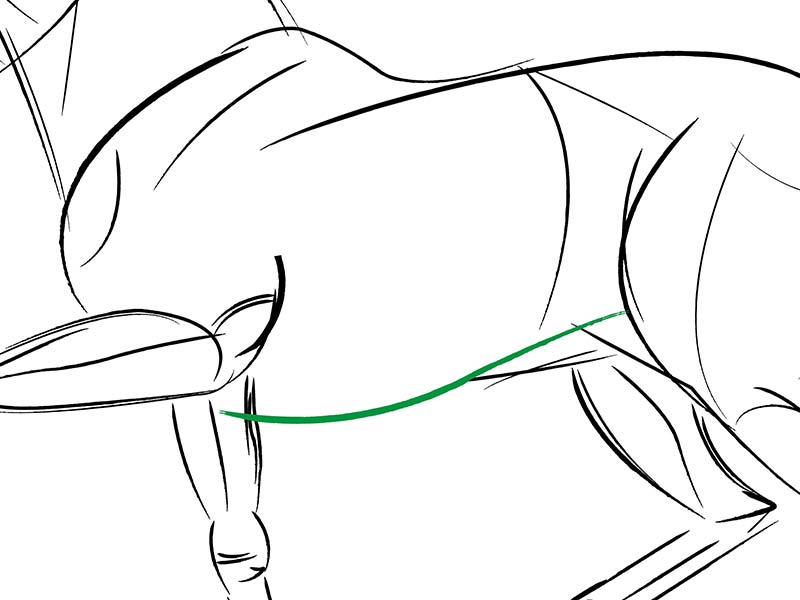
Horse type 2
A straight line between the belt line and the end of the sternum.
The girth position is well defined here, and the saddle girth is positioned far enough away from the elbow.
Horse type 2 is suitable for a wide range of riding disciplines, including dressage, show jumping and eventing. Its well-proportioned build ensures good balance and carrying capacity, as well as versatility.
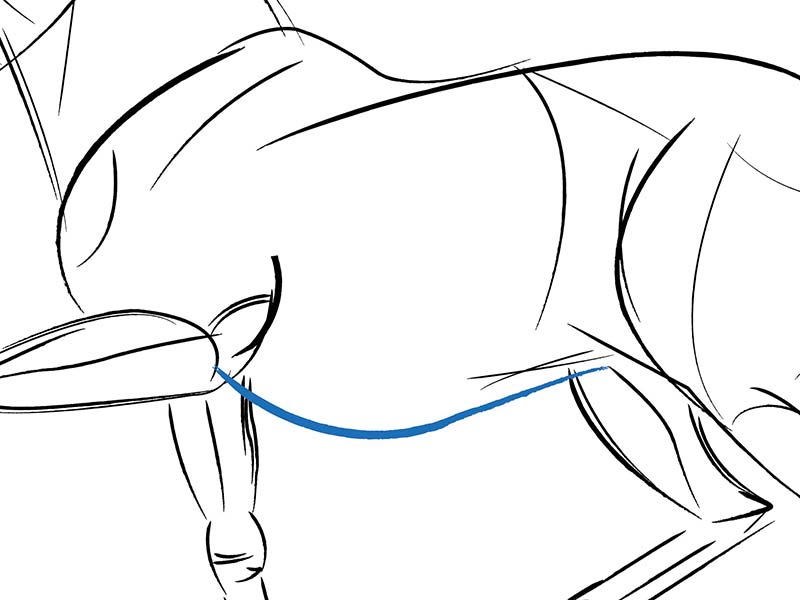
Horse type 3
A rounded body shape, broad ribcage and narrow chest.
In this case, the girth is automatically tilted sharply forwards and there is no straight section; consequently, the saddle girth also tilts sharply forwards.
Due to its narrow chest, Horse Type 3 is found in less demanding disciplines, such as trail riding or leisure riding. The broad ribcage enhances stability at slow gaits.
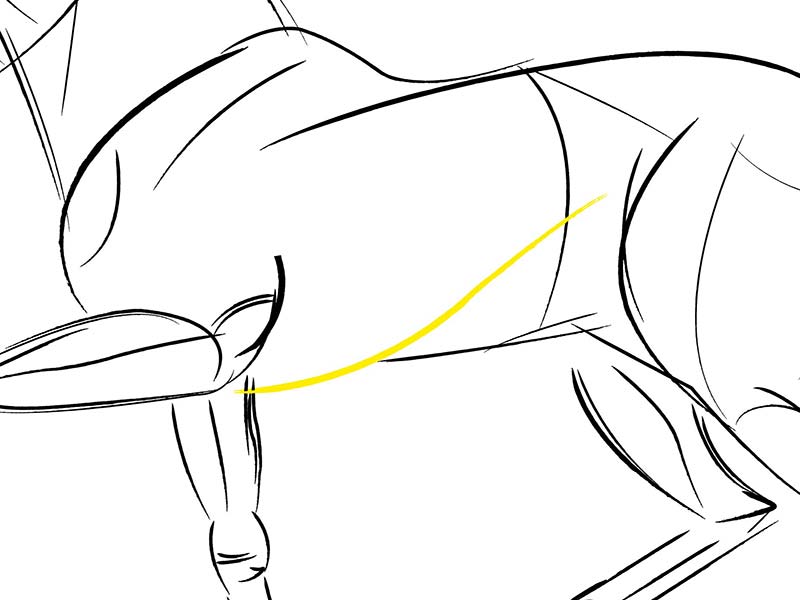
Horse type 4
A wedge-shaped build with a steeply sloping ribcage.
As with types 1 and 3, the girth is not positioned straight here either; however, the sternum is tilted upwards rather than downwards. As a result, the saddle girth presses against the sternum at the back.
Horse type 4 is particularly well suited to disciplines such as trail riding or endurance riding, where stamina, agility and cross-country ability are important.
An introduction to the world of saddle girths
Now that we know what types of horse there are, what characteristics they have in the girth area, and which disciplines these are best suited to, the next question is: what types of saddle girths are there, and how do they differ? Even though ever more innovative girth designs are coming onto the market, there are still essentially four main types, which we’d like to introduce to you below.

The symmetrical saddle girth
The symmetrical saddle girth, also known as an anatomical saddle girth, is ‘reversible’, meaning it has the same shape at the front and the back. The breastplate is shaped symmetrically at the front and back; the front and rear edges are also identical and may, but need not, be anatomically designed to allow sufficient elbow room.
Our most popular symmetrical saddle girths
Our most popular symmetrical saddle girths
Would you like to discover our full range of belts?
The crescent-shaped saddle girth
The crescent-shaped saddle girth stands out due to its distinctive shape, which resembles a crescent moon – that is, it curves sharply forwards. Many crescent-shaped saddle straps also feature an anatomical cut-out at the front edge of the strap to allow sufficient elbow room. The rear edge of a crescent-shaped saddle strap is usually cut straight across.

Our most popular moon-shaped saddle girths:
Would you like to discover our full range of belts?

The athletic saddle girth
The athletic saddle girth curves backwards overall, whilst the breastplate is shaped to curve forwards. The front edge is often anatomically shaped, thus providing sufficient elbow room. The rear edge is usually cut in a simple style.
The athletic girth is a fairly rare type in English-style riding. This type of girth is often used on racehorses.
Would you like to discover our full range of belts?
It is clear that horses are not only fascinating but also highly individual creatures, whose physique has a significant influence on the choice of the right girth. It is therefore particularly important to fit each horse with the right product to accommodate its specific anatomical features. In this way, we can ensure that our four-legged friend and partner receives the best possible support.
In Part 3 of our girth series, we’ll tell you which girth is suitable for which horse …
… and how to find the right harness.